Intermediate Bulk Containers (IBCs) are widely used in chemical, food, and pharmaceutical industries. Thorough cleaning before reuse is critical for preventing cross-contamination and extending container service life. The high-pressure water jet washing line, centered on 3D rotating jet technology and integrated with automated conveying and water recycling systems, achieves efficient and standardized cleaning of IBC interiors and exteriors. The following sections address working principles, system composition, and key design features.
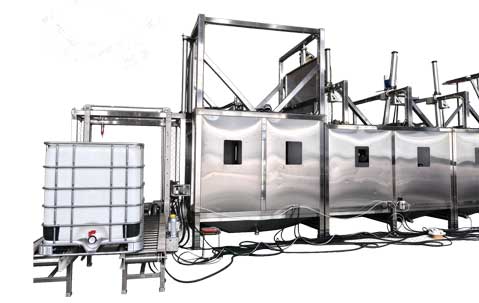
Working Principle and Process
This proposal presents an integrated fully-automatic high-pressure water cleaning system designed for standard 1000L IBC totes. It integrates six core functions: external surface spray cleaning, internal 3D rotary high-pressure cleaning, automatic chemical dosing cleaning, hot-water cleaning, hot-air drying, and wastewater circulation & purification. Operating in an automated assembly-line mode with full PLC intelligent control, the equipment requires minimal manual intervention. It thoroughly removes residual chemical raw materials, oil stains, viscous contaminants, sediments and other impurities from both the interior and exterior of the containers. It is applicable to reusable metal/plastic IBC totes used in the chemical, food, pharmaceutical, coating, grease and other industries. The system features high cleaning efficiency, strong decontamination capability, energy-saving and environment-friendly performance, stable operation and easy handling. It strictly conforms to industrial environmental cleaning standards, realizing standardized, automatic and harmless cleaning of IBC totes.
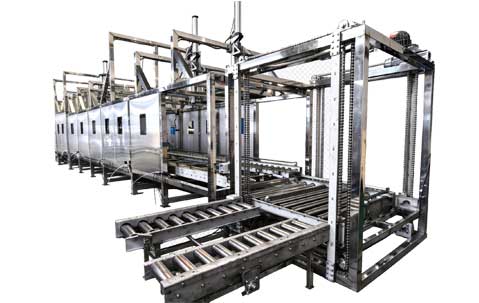
Cleaning Process
Manual forklift loading → Automatic feeding of totes by conveyor → Automatic positioning and locking of IBC tote → Pre-spray external washing → Steam fumigation → Chemical agent circulating cleaning (alkaline washing) → Internal 3D rotary high-pressure hot-water cleaning → Internal suction and automatic residual-water drainage → Hot-air drying → Pressure-holding leak test → Discharge of qualified totes
System Composition and Automation
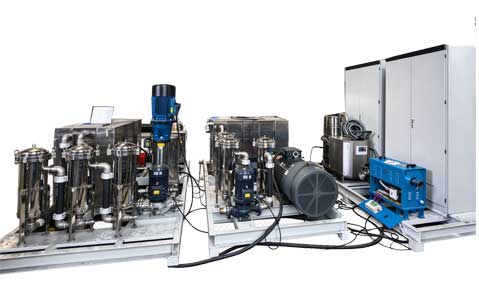
A complete high-pressure IBC washing line typically comprises a conveying system, high-pressure pump station, washing stations, water treatment system, and a PLC control unit. The conveyor uses a chain or roller design, with some configurations inclined at 5° to facilitate process water drainage. Washing stations may be open-style, allowing manual inspection and intervention with cycle times of 10–30 seconds, or enclosed for better containment of splashing and aerosols.
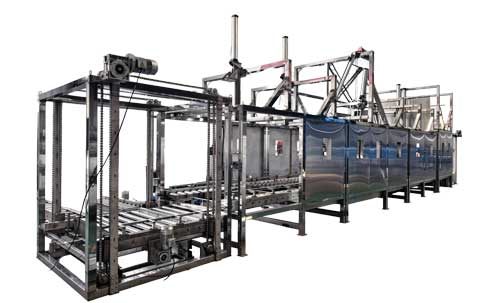
The control system incorporates automatic detection devices with water-shortage and power-loss protection. Proximity switches ensure accurate tote positioning, while lifting arms control the vertical movement of the 3D cleaning nozzle. The equipment is designed for continuous 24-hour operation. The pump station features a built-in deceleration mechanism for low noise, along with a booster pump to raise inlet water pressure.
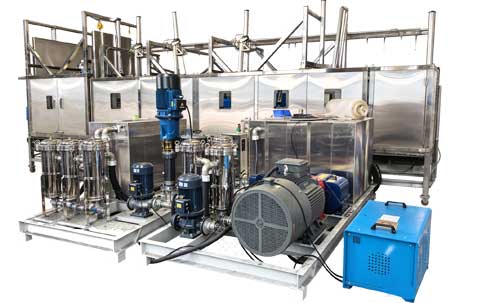
Water Treatment and Filtration
The sustainability of a high-pressure washing line depends largely on water recycling. A collection tray beneath each washing station directs water into a circulating sedimentation system; after multi-stage settling, the water enters a clean-water tank for reuse. The stainless-steel filtration system serves two critical functions: ensuring clean water enters the high-pressure pump to protect the pump and its wearing parts, and filtering the air supply for the drying stage to prevent contaminants from entering cleaned containers.
Drainage operates by gravity, with drain durations adjustable from 5 to 60 seconds depending on process requirements. Cleaning duration is also programmable to accommodate different residue types and cleanliness levels.
Conclusion
The technical value of the high-pressure IBC washing line lies in integrating the physical cleaning force of high-pressure jets, the repeatability of automated positioning, and the resource efficiency of water recycling into a single system. Its standardized and integrated design allows it to operate as a standalone unit or as part of a larger container reconditioning line, providing verifiable cleaning assurance for container reuse in chemical, food, and pharmaceutical applications.

Please contact us for free quotation by form below. We promise the quickest response within 24 hours: