Regenerative air preheaters are critical heat exchange components in coal-fired power plants and industrial boiler systems, but they are prone to ash and ammonium salt deposition, reducing efficiency and increasing energy consumption. This paper proposes an automatic cleaning device design based on high-pressure water jet technology and analyzes optimization paths for online cleaning methods. By optimizing nozzle layout, target distance control, and automation system integration, the device addresses issues of uneven cleaning, low efficiency, and metal damage in traditional methods. Experiments and case studies demonstrate that the device significantly reduces air preheater pressure differences, improves heat recovery efficiency, and prevents secondary issues such as filter bag adhesion.
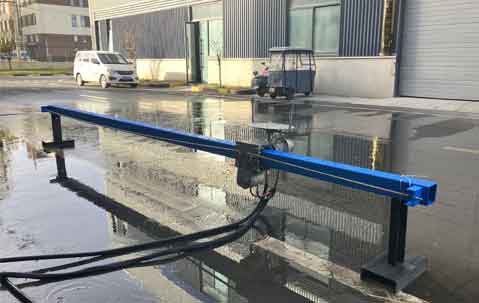
Air preheater fouling, caused by ash and viscous ammonium bisulfate (ABS) deposits, remains a persistent issue in power generation and industrial boiler systems. Traditional manual cleaning methods are labor-intensive, inefficient, and pose safety risks. In contrast, automated high-pressure water jet systems offer a robust solution for continuous operation. This article explores the design principles, technical advancements, and practical implementations of such systems, emphasizing their role in enhancing boiler efficiency and reducing downtime.
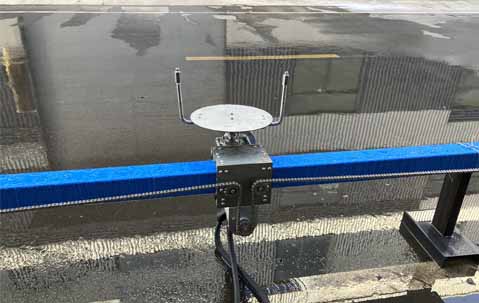
System Design and Key Components
Nozzle Configuration and Optimization
•Self-Propelled Rotary Sprinklers: The core executive component of the device, these sprinklers utilize eccentrically arranged nozzles to generate reactive torque, enabling autonomous propulsion and rotation within pipelines. Parameters such as nozzle count, inclination angle, and eccentricity are optimized to ensure stable motion and uniform cleaning
Automated Motion Control
• Radial Uniformity Adjustment: Traditional cleaning systems suffer from uneven radial water distribution due to varying linear velocities of rotor components. The proposed device incorporates programmable step-by-step traversal, where nozzles pause longer in inner regions and move faster outward, ensuring consistent impact across all heat exchange elements
• Multi-Axis Manipulation: Using X-Y axis drive structures and hydraulic swing arms, the system controls nozzle trajectories to cover the entire preheater surface. For example, hydraulic cylinders adjust connecting rods to alter spray angles dynamically
• Offline Cleaning Actuators: Fully autonomous actuators enable 360° coverage with horizontal and vertical traversal, eliminating dead zones. Remote operation further enhances safety and precision
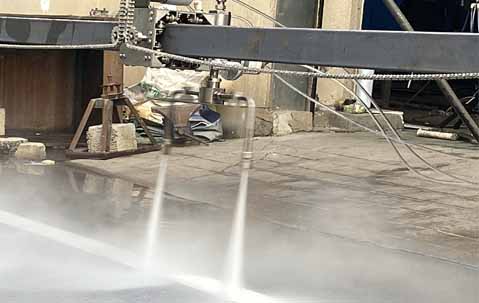
Technical Innovations and Performance Optimization
Online Cleaning Without Isolation
High-Pressure, Low-Flow Design: Compact systems deliver water at up to 300 bar with minimal flow rates, preventing thermal shock to enamel-coated heat exchange elements. This avoids stress-induced damage and preserves component longevity .
Energy and Resource Efficiency
Target Distance Optimization: Experimental data show that jet impact force peaks at specific nozzle-to-surface distances (typically 50–100× nozzle diameter). Beyond this range, efficiency declines sharply .
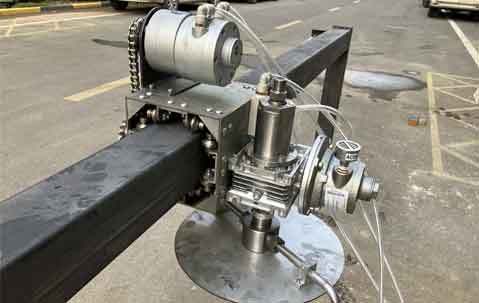
Automated high-pressure water jet cleaning devices represent a significant advancement in air preheater maintenance. By integrating optimized nozzle designs, intelligent motion control, and real-time monitoring, these systems enhance operational efficiency, extend equipment lifespan, and reduce environmental impacts. Future developments may focus on AI-driven adaptive cleaning and hybrid media (e.g., steam-air-water) for broader applications.

Please contact us for free quotation by form below. We promise the quickest response within 24 hours: